Full-scope photometric, chromaticity and light-distribution testing for motor-vehicle lighting devices, signalling lamps and retro-reflectors, covering GB, UN/ECE, FMVSS 108, SAE and ADR regulatory frameworks — one submission, multi-market certification.
Introduction
A vehicle lamp is the only safety component that operates day and night without interruption. Its luminous intensity, chromaticity and light distribution directly determine how much a driver can see at night — and how much a driver can be dazzled by it. Both failure modes leave no physical trace on the finished vehicle, yet they are among the most strictly policed items in regulatory and OEM acceptance. The difference between a compliant lamp and a non-compliant one is absolute, yet line inspection all too often reduces to a visual “does it light up” check. For products destined for global markets, the situation is far more demanding: the EU applies UN R.148/R.149/R.150, the United States applies FMVSS 108 together with SAE recommended practices, Australia applies ADR, and China has just completed a consolidated round of mandatory national standard revisions across 2024–2025. Divergent standards, unclear version-transition deadlines and inconsistent acceptance criteria are the three most common hidden risks in vehicle lighting export today. SRC-TEST’s vehicle lighting optical performance laboratory integrates a precision photometric turntable, photometer, colorimeter and retroreflectometer to deliver one-stop verification for lighting devices, signalling devices and retro-reflectors used on both cars and motorcycles — with a complete, certification-ready data trail supporting type approval, OEM part approval and export compliance.
01 Why Vehicle Lighting Optical Performance Testing Is Mandatory
| Dimension | Why it matters |
|---|---|
| Regulatory mandate | Luminous intensity, chromaticity and photometric distribution are core items of mandatory safety standards in every major market. Failure means no type approval and no market access. |
| Glare hazard | Incorrect beam angle or intensity dazzles oncoming drivers, generating complaints and recalls — and in some jurisdictions constitutes an illegal modification. |
| Signal recognition failure | A chromaticity deviation in a signalling lamp can prevent other road users from correctly identifying a turn or brake indication at the required distance, creating a direct accident cause. |
| Photometric drift | Plastic lenses shift their light pattern after thermal cycling, light-source irradiation and mechanical wear — the lamp still lights up, but no longer conforms. |
| Trade barrier | European, North American and Australian markets enforce mandatory certification; without the corresponding test reports, goods cannot be cleared or sold. |
| OEM gatekeeping | Vehicle manufacturers run incoming photometric spot checks on lamps. Failure against the OEM specification means rejection and claims. |
02 Scope of Testing
2.1 Optical Performance Testing of Vehicle Lighting Devices
Covers headlamps, high-beam and low-beam headlamps, front fog lamps, daytime running lamps, cornering lamps and front direction indicators. Verifies luminous intensity distribution, chromaticity coordinates and photometric distribution.
- Photometric distribution measurement: luminous intensity is measured point-by-point across the grid of test points and test areas defined by the applicable standard, then assessed for compliance with low-beam and high-beam distribution requirements
- Cut-off line verification: position, shape and gradient of the low-beam cut-off line — the parameter that directly governs oncoming-traffic safety
- Photometry: luminous intensity, target luminous flux, illuminance and photometric stability
- Colorimetry: chromaticity coordinates of both the light source and the complete lamp, assessed against the regulated color boundaries
- Aiming and alignment: mechanical aiming of headlamps and measurement of cut-off line shift
2.2 Optical Performance Testing of Vehicle Signalling Devices
Covers direction indicators, stop lamps, position lamps, side-marker lamps, parking lamps, rear registration plate illumination lamps, reversing lamps and rear fog lamps. Verifies luminous intensity, chromaticity and photometric distribution.
- Chromaticity compliance: confirms the emitted light falls within the color boundary coordinates defined by the regulation
- Photometric performance: effective luminous intensity, luminous flux and photometric distribution
- Light distribution: luminous intensity across the specified observation angles, and minimum visibility angles
- Apparent lens surface area: measurement of the effective light-emitting surface using the prescribed geometric method
- Function and flash characteristics: effective luminous intensity, flash frequency and signal colour testing for warning devices
2.3 Optical Performance Testing of Retro-Reflectors
Covers retro-reflectors for motor vehicles, motorcycles, mopeds and trailers, verifying photometric and colorimetric performance under passive illumination conditions.
- Shape, dimensions and construction: verification of the device body, mounting holes and reflective surface against the standard drawings
- Chromaticity: confirmation that the returned light colour falls within the regulated boundaries
- Luminous intensity: measurement of returned intensity at the specified observation and incidence angles
- Environmental endurance: thermal resistance, fuel resistance, lubricant resistance, corrosion resistance, impact resistance, dust and water ingress protection
2.4 Motorcycle Lighting Optical Performance Testing
Covers headlamps, position lamps, rear position lamps, stop lamps, direction indicators, licence plate lamps and retro-reflectors for motorcycles and mopeds, aligned with the 2025 series of Chinese motorcycle standards.
03 Test System and Core Equipment
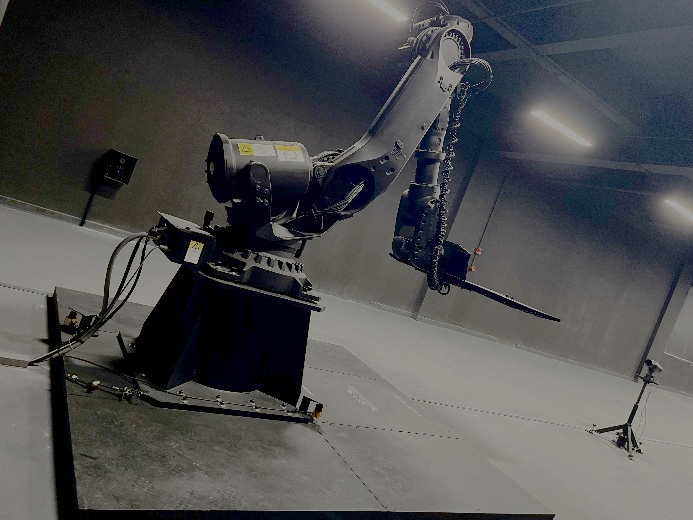
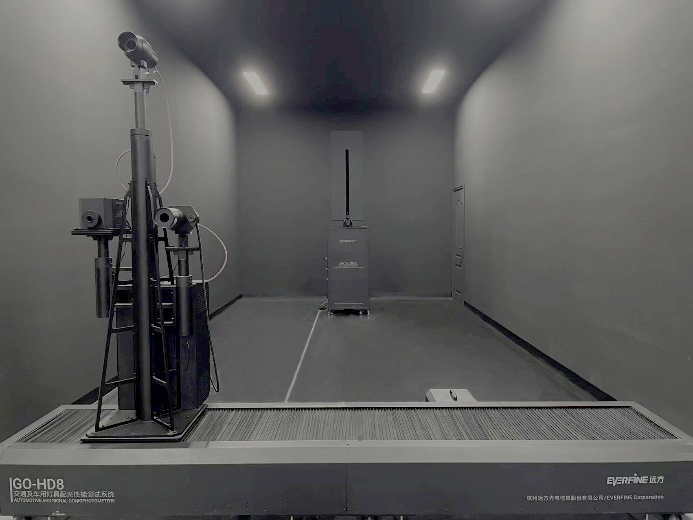
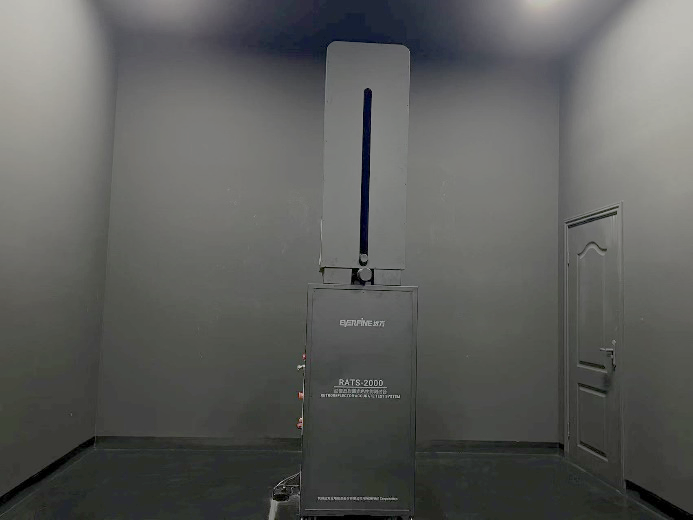
Our photometric distribution test system integrates a precision optical turntable, photometer, colorimeter and retroreflectometer, capable of optical verification at both lamp-level and module-level.
| Equipment / System | Role in Testing |
|---|---|
| Precision photometric turntable | Carries the lamp and scans continuously through the angles specified by the standard, completing full-spatial photometric distribution measurement |
| Photometer | Receives flux from the lamp under test and converts it into an intensity signal — the primary source of photometric and illuminance data |
| Colorimeter / spectroradiometer | Measures chromaticity coordinates of the light source and the lamp, for colorimetry compliance assessment |
| Retroreflectometer | Measures returned luminous intensity of retro-reflectors at the specified observation and incidence angles |
| Headlamp aiming equipment | Performs mechanical aiming of headlamps, cut-off line verification and alignment accuracy assessment |
| Environmental endurance facilities | Support thermal cycling, vibration, salt spray, dust and water ingress protection, and light-source irradiation projects |
Note: The equipment list and technical specifications should match the actual published capability page. Verify model, measuring range and accuracy before publication to avoid overstating equipment capability.
04 Global Standards Coverage
Our laboratory covers GB (China), UN/ECE, FMVSS 108 and SAE (US), ADR (Australia) and ISO standards for type approval of interior and exterior lighting and light-signalling devices across motor vehicles, motorcycles, electric bicycles, special-purpose vehicle warning devices, airport signals, high-speed rail signalling and marine lighting.
4.1 Chinese National Standards (GB) — Current Framework
⚠️ China’s mandatory vehicle lighting standards were substantially consolidated across 2024–2025. A large number of legacy standards have been superseded. See 05 Standard Transition Notice.
| Product Category | Current Test Standard | Principal Test Items |
|---|---|---|
| Headlamps / front fog lamps / daytime running lamps / cornering lamps | GB 4599-2024 Road illumination devices and systems for motor vehicles | Chromaticity; photometric distribution; target luminous flux of low-beam light source modules; illuminance and chromaticity stability; photometric distribution stability; cut-off line shift; colour rendering; UV content; mechanical wear (plastic lenses); coating adhesion (plastic lenses); transmissivity and diffuse transmittance; light-source irradiation; chemical resistance; internal thermal performance; plastic lens material tests |
| Position / rear position / outline / stop / direction indicator / reversing / parking lamps, side-marker lamps, rear registration plate illumination, rear fog lamps | GB 5920-2024 Light-signalling devices and systems for motor vehicles and their trailers | Chromaticity; photometric performance; photometric distribution; apparent lens surface area; cut-off line shift; thermal resistance (rear fog lamps and daytime running lamps); dust and water ingress protection; vibration; salt spray; deformation |
| Retro-reflectors | GB 11564-2024 Retro-reflectors for motor vehicles | Shape, dimensions and construction; chromaticity; luminous intensity |
| Motorcycle lighting devices | GB 19152-2025, GB 17510-2025, GB 18100-2025 | Photometric distribution and installation requirements for motorcycle headlamps and signalling devices |
| Environmental endurance | GB/T 10485-2025 Road vehicles — Lighting and light-signalling devices — Environmental endurance | Thermal cycling; sealing; thermal shock; thermal deformation; salt spray; dust protection; random vibration; impact vibration; water ingress protection; resistance to lubricating oil, fuel and cleaning fluid; light-source irradiation; fogging test |
| Special-purpose vehicle warning lamps | GB 13954-2009 Warning lamps for police cars, fire engines, ambulances and engineering rescue vehicles | Effective luminous intensity; flash performance; signal colour; vibration; water ingress protection; dust protection; corrosion resistance; deformation |
4.2 United Nations Regulations (UN/ECE)
Important: Since November 2019, UN/ECE has consolidated its previously separate lighting regulations into three unified regulations. New type approvals should reference R.148 / R.149 / R.150. The legacy regulations (R4, R6, R7, R23, R38, R50, R77, R87, R91, etc.) remain valid only for historical type approvals.
| Function Category | Current Unified Regulation | Superseded Individual Regulations |
|---|---|---|
| Light-Signalling Devices (LSD) | UN R.148 — rear position, stop, direction indicator, outline, side-marker, reversing, parking, daytime running, rear fog lamps and rear registration plate illumination | R4, R6, R7, R23, R38, R50, R77, R87, R91 |
| Road Illumination Devices (RID) | UN R.149 — headlamps, adaptive front-lighting systems, front fog lamps, cornering lamps | R19, R98, R112, R113, R119, R123 |
| Retro-Reflective Devices (RRD) | UN R.150 — retro-reflectors, contour markings and warning triangles | R3, R27, R69, R70, R104 |
| Warning lamps | UN R.65 — direction-indicator warning lamps and special optical warning devices | — |
| Installation | UN R.48 — positioning, quantity and wiring requirements for lighting and light-signalling devices | — |
| Motorcycle lighting | UN R.148 (Category L signalling lamps), UN R.149 (motorcycle headlamps) | UN R.50 |
4.3 United States Federal Regulation and SAE Standards
FMVSS 108 (49 CFR 571.108) is the United States mandatory federal regulation for lamps, reflective devices and associated equipment, administered by NHTSA. It applies to passenger cars, multipurpose passenger vehicles, trucks, buses and trailers (excluding pole trailers and trailer converter dollies) and motorcycles, and also governs the replacement equipment market.
| Lamp Category | SAE Recommended Practice | Scope |
|---|---|---|
| Clearance / side-marker lamps | SAE J592 | Clearance and side-marker lamps for vehicles less than 2032 mm overall width |
| Rear position lamps | SAE J585 / J2040 | Tail (rear position) lamps for vehicles less than / greater than 2032 mm overall width |
| Stop lamps | SAE J586 / J2261 | Stop lamps and turn signal lamps for vehicles less than / greater than 2032 mm overall width |
| Turn signal lamps | SAE J588 / J2261 / J914 | Turn signal lamps for vehicles less than 2032 mm overall width; stop and turn signal lamps for vehicles ≥ 2032 mm; side turn signal lamps for vehicles less than 12 m in length |
| Rear registration plate illumination | SAE J587 | Rear licence plate illumination devices |
| Reversing lamps | SAE J593 | Back-up (reversing) lamps |
| Parking lamps | SAE J222 | Parking (front position) lamps |
| Rear fog lamps | SAE J1319 | Fog tail lamp (rear fog light) systems |
| High-mounted stop lamps | SAE J1432 | Rear high-mounted stop lamps and rear high-mounted turn signal lamps for vehicles ≥ 2032 mm overall width |
| Retro-reflectors | SAE J594 | Reflex reflectors |
| Headlamps / front fog lamps | SAE J584 / J583 / J1383 / J2650 | Motorcycle headlamps; front fog lamps; replaceable-bulb headlamps; LED road illumination device systems |
| Authorized warning lamps | SAE J845 / J887 / J595 | Optical warning devices for authorized emergency, maintenance and service vehicles; school bus warning lamps; directional flashing optical warning devices |
| School bus signalling lamps | SAE J131 / J595 | School bus stop arm and warning lamps |
California additional requirements: California and other state-level markets that adopt California regulations must additionally satisfy the California Code of Regulations, Title 13, Division 2, Chapter 2, Article 22, which imposes supplementary lamp installation and use requirements.
4.4 Australian ADR Regulations
| Product Category | Test Standard |
|---|---|
| Signalling devices | ADR 86/00 (stop lamps), ADR 48/00 (rear direction indicator lamps), ADR 49/00 (contour markings), ADR 60/00 (direction indicator lamps), ADR 62/00 (daytime running lamps), ADR 76/00 (parking lamps), ADR 51/00 (public service vehicle lighting) |
| Road illumination devices | ADR 50/00 (headlamps / front fog lamps) |
| Retro-reflectors | ADR 47/00 |
| Warning devices | ADR 52/00 (warning devices for emergency vehicles), ADR 53/00 (warning triangles), ADR 6/00, ADR 1/00 |
| Motorcycle lighting | ADR 42/00 (direction indicator lamps), ADR 43/00 (rear position lamps) |
4.5 ISO International Standards
| Product Category | Test Standard | Notes |
|---|---|---|
| Retro-reflective devices | ISO 6742-2:2015 | Corresponding adoption GB/T 31887.2; covers optical and physical requirements for bicycle retro-reflectors |
| Electric bicycles | GB/T 31887.2 (current edition), GB 17761 | Performance requirements for electric bicycle retro-reflectors |
Note: GB/T 31887.2-2019 is withdrawn on 1 November 2026 and superseded by GB/T 31887.2-2025. Confirm the applicable edition at the time of submission when testing bicycle retro-reflectors.
05 Standard Transition Notice
This section is a key point of interest for website visitors and directly affects submission decisions. It is recommended to retain it and update it regularly.
China’s mandatory national standards for vehicle lighting completed a substantial consolidation across 2024–2025, superseding a large number of legacy standards in full. Reports issued against superseded standards may result in invalidated type approval or refused certification.
| Current Standard | Effective Date | Superseded Standards |
|---|---|---|
| GB 4599-2024 Road illumination devices and systems for motor vehicles | 2025-07-01 | GB 4599-2007, GB 4660-2016, GB 21259-2007, GB 25991-2010, GB/T 30036-2013, GB/T 30511-2014 |
| GB 5920-2024 Light-signalling devices and systems for motor vehicles and their trailers | 2025-07-01 | GB 5920-2019, GB 15235-2007, GB 11554-2008, GB 17509-2008, GB 18408-2015, GB 18409-2013, GB 18099-2013, GB 23255-2019 |
| GB 11564-2024 Retro-reflectors for motor vehicles | 2025-07-01 | GB 11564-2008 |
| GB/T 10485-2025 Road vehicles — Lighting and light-signalling devices — Environmental endurance | 2025-08-01 | GB/T 10485-2007 |
| GB 19152-2025 / GB 17510-2025 / GB 18100-2025 Motorcycle series | 2026-01-01 | GB 19152-2016, GB 17510-2008, GB 18100-2013 |
| GB/T 31887.2-2025 Bicycle retro-reflective devices | — | GB/T 31887.2-2019 withdrawn on 2026-11-01 |
Transition period arrangements (illustrated by CQC automotive CCC certification rules): transition deadlines differ by product category. For example, newly submitted front fog lamps and cornering lamps are covered from 1 July 2025, while new low-beam and high-beam headlamps begin implementation 19 months after the new standard takes effect, and products already holding type approval begin at month 37. Always confirm the applicable transition schedule against the certification rules in force at the time of submission.
FMVSS 108 and the SAE recommended practices are continuously updated by NHTSA and SAE respectively. When citing them, note “executed per the version in force at the time of submission” rather than locking to a specific version number, to prevent the information from becoming obsolete.
06 Test Process
01 Requirement and standard confirmation — Confirm product category, target market, certification route and the applicable standard list; proactively advise clients of implementation deadlines where version-transition periods apply. 02 Sample receipt and visual inspection — Verify sample quantity, model and accessories; record pre-existing defects and initial condition. Lamps must function correctly when powered. 03 Mounting and alignment — Mount the lamp on the turntable in the manner prescribed by the standard, set the measurement axis and reference plane, and complete mechanical aiming for headlamps. 04 Photometry and distribution measurement — The turntable scans through the specified angles while full-spatial luminous intensity distribution is acquired, generating photometric curves and test-point data tables. 05 Colorimetry — Measure chromaticity coordinates of the light source and lamp; assess compliance with color boundaries. 06 Supplementary testing — Conduct cut-off line shift, apparent lens surface area, photometric stability and module luminous flux tests as required by the applicable standards. 07 Data review and evaluation — Evaluate each parameter against the standard limits, flag non-conformities and trace them back to the specific test points. 08 Report issuance and corrective-action support — Issue the complete test report and provide failure-cause analysis and design rectification recommendations.
07 Common Failure Modes and Compliance Risks
| # | Common Failure Point | Typical Manifestation | Recommended Action |
|---|---|---|---|
| 1 | Cut-off line out of tolerance | Low beam visibly “lifted” or “dipped”, causing glare for oncoming traffic | Check light-source module warm-up state and lens assembly tolerances before adjustment |
| 2 | Chromaticity drift | Lamp shifts in colour over time and exits the color boundary | Assess light-source spectral stability and coating weatherability; verify colour shift after light-source irradiation |
| 3 | Thermal photometric shift | Passes cold, fails at thermal steady state | Perform illuminance and chromaticity stability, and photometric distribution stability testing per the standard |
| 4 | Plastic lens wear | Surface scratching reduces transmittance, producing striping in the light pattern | Execute mechanical wear and coating adhesion tests in the prescribed appendix sequence |
| 5 | Lamp-level testing only | Module-level parameters (luminous flux, colour rendering, UV content) not addressed | Define the submission level explicitly to cover both complete lamps and light source modules |
| 6 | Submission against superseded GB standards | Report cites withdrawn standards; certification not accepted | Verify the current status and transition schedule of standards before submission |
| 7 | Assuming legacy UN R.6/R.7 still apply | New approvals citing regulations that have already been consolidated | Reference UN R.148/R.149/R.150 for all new projects |
| 8 | Photometry and colorimetry without environmental testing | Optically compliant but sealing and durability inadequate; still rejected by the vehicle manufacturer | Schedule GB/T 10485-2025 environmental endurance projects in parallel |
08 Service Advantages
One submission, multiple markets — A single test system executes GB, UN/ECE, FMVSS 108, SAE and ADR standards in parallel, reducing sample transfer and coordination overhead across multiple laboratories. Version tracking that keeps pace with the standards — Our team continuously monitors revisions and withdrawals of national, UN and SAE standards, and advises on applicable versions and transition deadlines before submission — avoiding costly certification rework. Complete data you can actually certify with — Reports provide not only pass/fail judgements but also the underlying photometric curves, test-point data tables and chromaticity coordinates, directly supporting type approval documentation and OEM acceptance. More than a report — For non-conformities, we provide failure-cause analysis and design rectification recommendations covering lens structure, light-source selection and driver schemes, shortening the corrective-action cycle. Extending from optics into reliability — Beyond optical performance, the same laboratory can support GB/T 10485-2025 environmental endurance and vehicle lamp fogging tests, avoiding repeat sample submission.
09 Contact Us
Whether your goal is market access in Europe, North America or Australia, domestic mandatory certification, or OEM part approval, we deliver optical performance verification in a single pass. Service flow: Requirement and standard confirmation → Test plan and quotation → Sample receipt → Photometric and colorimetric testing → Data review → Report issuance → Rectification support
- [Request a tailored test plan]
- [Download the laboratory capability brochure]
- [Phone / Email / Address / Online enquiry form]
Testing venue and equipment: